
Sam Leske

Sam developed his passion for astronomy from an early age and recalls seeing Halley’s Comet with his great uncle who also saw it in 1910. He joined the Royal New Zealand Air Force (RNZAF) in 1992 and studied for a BSc at the University of New South Wales before completing pilot training back in New […]
Laura Penrose: Student poster at AbSciCon2017

AbSciCon2017 AbSciCon2017 was held in Mesa, Arizona with scientists, students, and educators attending this conference to discuss and share ideas in Astrobiology. The theme for the conference was “Diverse Life and its Detection on Different Worlds”. One of the topics in the conference was “Astrobiology as a Human Endeavor” where student, Laura Penrose, presented her […]
The next rover mission to Mars in 2020 to search for biosignatures — how New Zealand’s hot springs are helping NASA choose the next landing site

A team, including Professor Kathy Campbell, attended a workshop sponsored by NASA and JPL on 8-10 February 2017 in Monrovia, California, where 250 scientists and engineers discussed where the next Mars rover, launching in 2020, should land. Kathy’s team presented arguments for one of the 8 remaining landing sites that were still under consideration – at Columbia Hills in Gusev Crater – and were successful in making it into the Final 3. Choice of The One will happen at the 4th Mars 2020 landing site meeting planned for 2018.
New Zealand: 2nd Space and Astrobiology Symposium

Join the 2nd Space and Astrobiology Symposium at the Canterbury University’s Westport Field Station, 9-11 April 2017. The symposium provides an opportunity to bring together a diverse group of researchers who share a common interest in the advancement of space exploration and astrobiology.
AbSciCon 2017

The Astrobiology Science Conference 2017 (AbSciCon 2017) will be held April 24–28, 2017 in Mesa, Arizona at the Mesa Convention Center (263 N Center Street, Mesa, AZ 85201) and the Phoenix Marriott Mesa (200 North Centennial Way, Mesa, Arizona 85201).
The theme for AbSciCon 2017 is “Diverse Life and its Detection on Different Worlds.” Mars and icy worlds in our solar system are increasingly recognized as habitable, even as increasing numbers of exoplanets in their stars’ habitable zones have been discovered. The focus is shifting from identification of habitable worlds, to detection of life on them.
A talk on asteroid preparedness. Professor Kathy Campbell

Where: Stardome Observatory, Auckland
When: 8PM, Monday, 14th of November 2016
On November the 14th, Professor Kathy Campbell will give a talk at the Auckland’s Astronomical Society monthly meeting, at the Stardome Observatory. She will talk about the ET impact event that wiped out the dinosaurs 66 million years ago. Professor Kathy Campbell is a geologist, expert in the history of stones.
Professor Kathleen Campbell is appointed Fellow of the RSNZ

Nineteen top New Zealand researchers and scholars have been announced as Fellows of the Royal Society of New Zealand an honour which recognises true international distinction in research and scholarship. Astrobiologist and Professor Kathleen Campbell, University of Auckland is among them. Congratulations and thank you for the support and dedication to New Zealand astrobiology.
Where is everyone?

Professor Kathy Campbell and Mark Sainsbury comment on Professor Brian Cox’s new article on the Fermi paradox
Rosetta
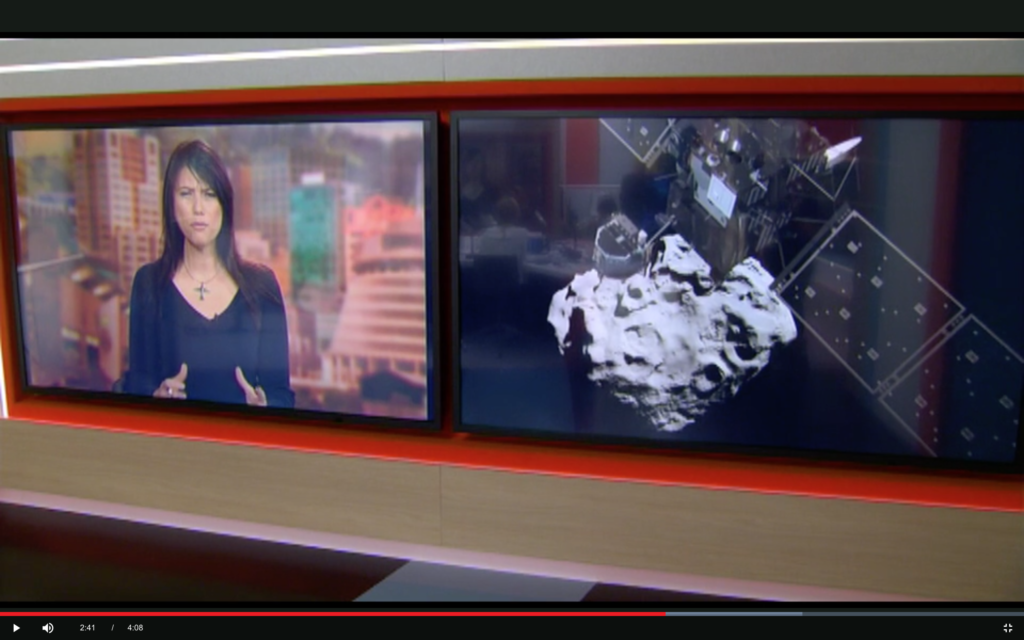
The European Space Agency’s (ESA) 12-year mission finally came to an end last week when the probe landed on the comet it made friends with over a decade ago. Astrobiologist Haritina Mogosanu joined Paul Henry to discuss Rosetta mission.
Europa in the news

Europa has been in the news lately, with NASA announcing a press conference way in advance to spark our interest about Jupiter’s moon, Europa.
Listen here to Kathy Campbell’s comments about life and Europa, while she is giving a great account on the possibilities of alien life.
.